Thursday, March 3, 2011

Lord of the Flies Powerpoint Notes

By popular demand...

Here are the Powerpoint notes from several of our classes over the unit.  If you weren't there, this may be a little confusing.  However, if you were, this should ring some bells and hopefully remind you of some of the things we talked about and give you some ideas of how to talk about themes in your final project.

Enjoy!

P.S. This is going to look a little weird because I had to convert it to Powerpoint from the Mac version (Keynote), so some stuff is a little out of place.


Wednesday, February 23, 2011

Final Project!

Lord of the Flies: The Final Project

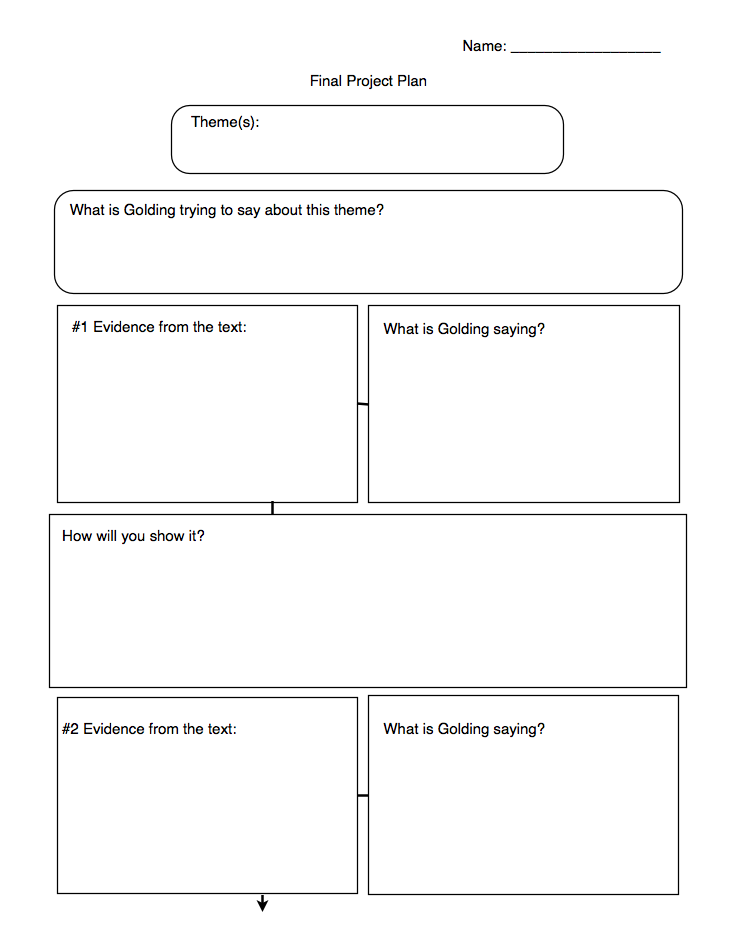
Due Yesterday: Project proposal that shows me your plan for each area of the project and the format you will be using so I can give you feedback and let you know if you’re way off track.  Please feel free to use one of two different graphic organizers shown below to organize your thoughts and ensure you've covered all the requirements.

Your project should do three things:
    1. Identify a theme in Lord of the Flies (i.e. Savagery vs. Civilization, the Nature of Evil, Rules and Order, Power, Loss of Innocence, Individualism vs. Community, Dehumanizing Relationships)
    2. Identify and prove with evidence Golding’s position on that theme (i.e. what does Golding use this book to say about Rules and Order in general).  That is to say, what is Golding using this book to say about the world in "big picture" terms.
    3. Provide your own position/opinion on this theme, whether it is similar to Golding’s or not (i.e. Is Golding right about what he says about Rules and Order in general?)

Format Suggestions:
    - Essay with attitude (good for college prep!)
    - Creative writing piece:
        - missing scenes from the story written as a narrative or script
        - newspaper article about “the incident” complete with photos
        - a scrapbook or diary
    - Comic strip (You can use the "Comic Life" program)
    - Poem (keep in mind, it would probably have to be on the long side to get your point across)   
    - Collage or other art piece - this would require a piece of writing explaining how your piece
       fulfills the requirements.
    - YouTube video
    - Multimedia presentation
    - A song
    - Board game
    - Any other suggestions you’d like to propose?


Monday, February 21, 2011

Sticky Note Assignment

Directions: This assignment was done in-class.  As we were reading chapter 9 aloud, you were to be writing down themes on sticky notes as you saw them come out in the book and place them where you see them.  After the reading, you were to write down the theme, where in the book you saw it, and your justification for why you think the theme is there.  To make up this assignment, review the book and as you come across a theme, write down the theme, it's location, and your justification.  You should provide me with five individual instances total.

Again, the themes are:

Savagery vs. Civilization
Individualism vs. Community
Nature of Evil (and the fear of it)
Man vs. Nature
Loss of Innocence
Dehumanizing Relationships
Rules and Order
Power
Identity

Effects Wheel: Theme

Directions: Show how Golding’s treatment of a theme affects the novel.  The theme should go at the center and around that theme should be eight ways that theme affects the novel. In the outer circle, show the effects those eight things in the novel have.  For instance, in the movie “Shrek”, the theme of “outward appearances” leads to “Shrek is judged based on his outward appearances,” which leads to “Shrek judges others based on their outward appearances” and “Shrek is hunted and isolated.”

Themes: 
Remember - events represent ideas!

Savagery vs. Civilization
Individualism vs. Community
Nature of Evil (and the fear of it)
Man vs. Nature
Loss of Innocence
Dehumanizing Relationships
Rules and Order
Power
Identity

Wednesday, February 16, 2011

Free Audiobook? Yes, please!

Are you having trouble keeping up with the reading?

Are there parts of the text that are confusing or unclear?

Do you want to review what you've read to prepare for the project, but don't want to spend the time rereading the book, trying to remember what happened?

Well, you've come to the right place.

     Audible is running a promotion right now where you can download one audio book for free if you sign up for their 14-day free trial. They have Lord of the Flies available and it is even read by the author, William Golding.

    Now this is key: DO NOT FORGET TO CANCEL YOUR ACCOUNT AFTER YOUR 14-DAY TRIAL.  Otherwise, you'll get stuck with the bill.  

    I strongly encourage you to download this!  I've gotten an indescribable amount of help from having the audio book.

Click here to be directed to the website!

Friday, February 11, 2011

What "Good" Readers Do - The Ten Dimensions of Reader Response


Adapted from the writings of Jeffrey D. Wilhelm


1. Entering the Story World: 
You prepare to read and start thinking about what the reading will be like. You think about knowledge you already have that will help you read.

2. Showing Interest in the Story Action:
You understand the literal meaning of the plot and become interested in it as you read. You make predictions and form expectations about story action.

3. Relating to Characters:
You create characters and take up relationships with them. You often become a presence in the story and make judgements about characters.

4. Seeing the Story World:
You notice clues for creating mental images and envision characters, settings, and situations.

5. Elaborating on the Story World:
You build up clues from throughout the story to create meaning.  You play detective, fleshing out clues, and filling in sto stary gaps, often creating meaning that goes well beyond that suggested by the text.

6. Connecting Literature to Life:
You make explicit connections between personal experiences and character experiences, often looking for ideas that can inform how you could solve problems or think about situations in your own life.

7. Considering Significance:
You ask how the text works to create meaning and think about the significance of various events and behaviour and how this contributes to the meaning of a story.

8. Recognizing Literary Conventions :
You notice that the author made particular kinds of conventional moves that you have to respond to, and you use previoius experiences with conventions from your reading, viewing, or talking to figure out how to do so.

9. Recognizing Reading as a Transaction:
You recognize the author and the choices of the author in telling the story. The author might be embraced or rejected as a person to converse and agree with. You see that YOU create meaning with the author and his or her text.

10. Evaluating the Author (and Self) as a Reader:
You consider the author's agenda, and your own. You think about the author's effectiveness as a writer. You consider your own reading processes and how these relate to your personal identity.

Second Interior Monologue Assignment

Interior Monologue:
Open Up That Brain and Let Us See Inside

Why do people do what they do and why do they think what they think?

Pick one of the characters we’ve discussed (Ralph, Piggy, Jack, Roger, Simon, Samneric, Littluns) or suggest another you’d like to use.  Look through your notes and the book to review your character and write down about 200 words of interior monologue in first person (I feel such-and-such and I think blahdeeblah).  “Interior Monologue” is just a formal way of saying that you write out what you imagine are the thoughts of a character in history, literature, or life at a specific point in time.  So basically - take what you know about the story and expand on it. If you use the "head" to get ideas (drawing pictures, writing down ideas), it will be worth one extra point if your grade is less than perfect. 

Two things that are different from the last interior monologue:
#1 Your character’s thoughts should revolve around or focus on one of the themes we have listed for this story. 
#2 You should be demonstrating your ability to relate to the character, which is the third of the dimensions of reader response that we have been looking at. 


But Miss Adsit why are we doing this?

    Writing interior monologues is a brain workout that takes your thinking about the book to a higher level.  By empathizing with people, no matter how different from you or despicable they seem, you are exploring the causes of human behavior.  If you can imagine why people do what they do, you can understand the world - not just this book- at a deeper level. The very act of considering, "How might this person experience this situation?" develops an important "habit of the mind” that gives you power and draws us closer together.  That’s why!

Themes To Keep In Mind:

Savagery vs. Civilization
Individualism vs. Community
Nature of Evil (and the fear of it)
Man vs. Nature
Loss of Innocence
Dehumanizing Relationships
Rules and Order
Power
Identity


Stuck?

Knowing what you do about your character, you may want to imagine what your character would say to the following questions.  You don’t need to include these specific answers in the monologue, but these questions are there to help you think about what your character is concerned with - you can choose one that sparks an idea and run with it:

How does he feel about the issue of the beast (the symbol of evil)?  What does he think the beast is?  How does he think the beast should be handled? 

How does he feel about hunting, if he has participated?  Does he get a sadistic pleasure out of it?  How does it make him feel? 

Is he thinking more like a human or like an animal?  Is he experiencing a change in identity?  Was he one way once he landed on the island and feels another way now?

Does he support or reject the rules and order and civilization? If so, why does he cling to them?  If not, why does he prefer savagery and lawlessness?

Does he crave power?  Does he feel powerless?

Is he only looking out for himself?  Or does he have the well-being of the group in mind?

Has he come to a new understanding of how the world is that has caused him to lose his innocence?


Copy this ^ and paste it in a document.